

Mousehold Heath Earth Heritage Trail

Mousehold Heath isn’t just a beautiful green space – it’s a window into millions of years of Earth’s history. The Earth Heritage Trail takes you on a journey through 18 fascinating points of interest, linking today’s landscape and wildlife with its deep geological past.

Discover Norwich’s hidden geological story!

What you’ll find:

  • Trail highlights: Old quarry sites, unique heathland habitats, and views that inspired famous artists.
  • Geology uncovered: Learn how Ice Age sands and gravels shaped the Heath.
  • Wildlife & history: Explore the plants, animals, and stories that make this area special.

Why it matters:
This trail is a partnership project celebrating Norwich’s natural and geological heritage. It’s perfect for walkers, families, and anyone curious about the story beneath their feet.

Getting there:

  • By car: Car parks at Britannia Road, Gurney Road, and Gilman Road.
  • By bus: Routes 11/12 (Sprowston Road) and 23/23a (Heartsease Lane/Salhouse Road).
  • On foot: Multiple entry points from Gilman Road, Gurney Road, Heartsease Lane, and Mousehold Lane.

Plan your visit:

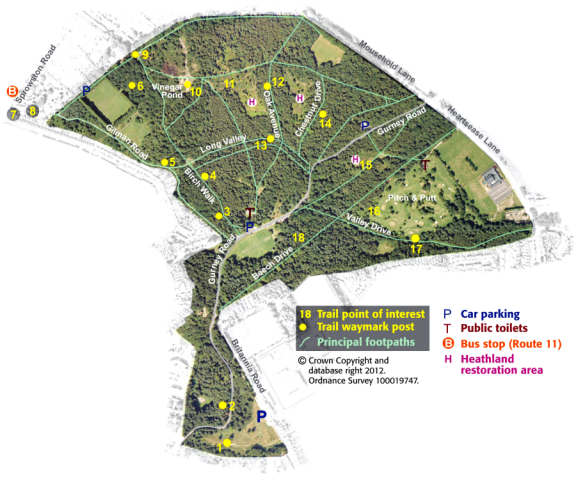
Earth trail map

Download a copy of the map now

Earth trail logos

Find out more about the points of interest below


Introduction

The landscape and geology of Mousehold Heath

Mousehold Heath has been part of Norwich life for over a thousand years. Its sand, gravel, lime, and flint helped build the city.

Today, it’s the last fragment of a vast heathland formed on Ice Age sands. In the 19th century, it was a rolling landscape of heather and bracken, dotted with quarry pits and alive with heathland wildlife. Sheep, rabbits, and firewood gathering kept it open.

Declared a public leisure space in 1886, the Heath is now a County Wildlife Site. Most of the old heath has grown into woodland, but pockets of original heath remain, carefully managed for rare wildlife.

Beneath its surface lies a fascinating Earth story - millions of years written in rocks and sediments. Explore its geodiversity, shaped by deep time and human activity. This leaflet introduces the Trail; more details are online.

Step into the story of Mousehold Heath - a landscape shaped by millions of years of geology and over two centuries of quarrying. Beneath your feet lies sandy soil that makes this area a rare and precious heathland habitat, home to an incredible variety of wildlife.

What’s on the Trail?

  • 18 points of interest are waiting to be explored.
  • Some are marked with wayposts, but you can visit them in any order.
  • Each stop reveals how today’s scenery and wildlife connect to the Heath’s deep geological past.

Use the map to find wayposts, car parks, and public toilets, and start your journey through time and nature.

1 - St James Hill

This is an outlying spur of the Mousehold plateau, giving wonderful views of Norwich and the Wensum valley. 

The valley began to form at the end of the Anglian glacial period, some 425,000 years ago. Mousehold Heath is underlain by a thick stack of glacial and Crag sediments.

A borehole near Britannia Barracks recorded 26 m (107 ft) of sand and gravel resting on Chalk. St James’ Hill is a good place to see one of the dry valley landforms of Mousehold. Dry valleys formed in permeable soils during the Ice Age, perhaps when climate was wetter and ground-water levels were higher, or in permafrost conditions, when the ground was frozen so it could be eroded by meltwaters. 

The sandy soils of St James’ Hill support heathland wildlife. Gorse and bramble scrub are being controlled to encourage other plants to flourish. Interesting bee and wasp species have been recorded from St James’ Hill. It is part of Mousehold Heath County Wildlife Site.

2 - St James’ Hollow

This impressive hole in the ground is one of the biggest chalk and gravel pits in the Norwich area. The Chalk is a limestone laid down in tropical seas during the Cretaceous period. St James’ Hollow is a Site of Special Scientific Interest, designated for its geological value as one of the best places in Britain to find the fossil remains of Mosasaurus.

There is interesting geology in the south pit. You can see Chalk beneath the basement bed of the Norwich Crag, a sandy marine deposit laid down about 2 million years ago. A boulder bed of large flint nodules was eroded out of the sea-bed by tidal currents. A similar environment can be seen today where Chalk rock is exposed along the Norfolk coast, as at West Runton.

3 - Upper Birch Walk

A small gravel pit near the top of Birch Walk shows some of the coarse glacial gravels which underlie the high ground of the Heath. These are thought to have been part of a ‘sandur’ or outwash plain at the end of the Anglian glacial period, perhaps 430,000 years ago. Tree clearance here will benefit heathland wildlife.

4 - Lower Birch Walk

A small sand pit shows geology from an older, deeper layer of Mousehold. Gravel is overlain by alternating layers of yellow sand and brown, clayey sand. The gravel was deposited by a meltwater stream flowing across a glacial outwash plain, while the sandy layers would have been deposited in quieter water - perhaps a lagoon. These layers may date from a glaciation older than the Anglian.

5 - Gilman Road bank

Gilman Road bank is the best place on the Heath to see the glacial sands and gravels which form the main body of Mousehold. Three cuttings have been made in the bank, allowing us to see what the environment close to the ice front was like. Chaotically-bedded gravels alternate with sands and thin clay seams. They were probably laid down on an outwash plain with slabs of dead ice, and unstable gravel bodies slumping into pools or streams of meltwater.

6 - Gilman Road brick pits

The sandy, glacial clays of Mousehold can be fired to make red bricks. These so-called ‘mussel bricks’ were made here in vast quantities until the late 19th century. There was a major brick field near Gilman Road; the site was landscaped and now lies beneath the Sports Ground.

7 - The Lazar House

Most of the building materials used in the walls of the Lazar House at Gilman Road would have been sourced from Mousehold, including the flint stone rubble and builders’ lime. The wall in the southwestern corner is buttressed with ‘mussel bricks’. The door frames are made of imported Barnack limestone transported by boat from the Peterborough area.

8 - Gilman Road lime kiln

The gardens of the block of flats in Gilman Road conceal a lime kiln. This was the last working lime kiln in Norwich (1968). The kiln was built about 200 years ago as a ring-shaped underground structure. Chalk was ‘burnt’ (calcined) here to make builders’ lime. It is preserved below ground, marked by a circle of gravel and shrubbery.

9 - Hooper Lane brick field

A hundred years ago this was a busy complex of brick pits and kilns. Brickearth lies beneath the layers of sand and gravel on Mousehold. The north-western slopes of the Heath were quarried away, and two picturesque windmills were destroyed. In the later 19th century a large Hoffmann kiln was built, allowing bricks to be made continuously, as the fire burned in rotation through a series of chambers. Brick making continued here until after World War 2.

10 - Vinegar Pond gravel pits

Sand and gravel has been dug on this part of the Heath since the Middle Ages. Quarrying stopped here after 1880. Fresh-looking hummocky ground nearby is probably the result of wartime dumping of soil. Vinegar Pond is a wet hollow left by the quarrying and wartime manoeuvres, fed only by rainwater.

11 and 15 - Heathland restoration areas

200 years ago, Mousehold was open heathland with very few trees. Local people dug for sand and gravel, herded livestock and collected firewood. These traditional land-uses ceased once the Heath became a public park, and trees began to invade. Today, the Conservators and Wardens are working together to restore as much of the open heath as possible; this work will benefit a wide variety of species.

12 - Oak Avenue brick pit

Until 1880 this leafy dell known as ‘Deep Hole’ was a scene of industrial activity, as the glacial brickearths of Mousehold Heath were quarried here for brick making. The sides of the valley made it easy for the diggers to get at the valuable silts and clay beds.

13 - Long Valley

Long Valley is the best example of a dry valley on the Heath, formed in the past when groundwater levels were higher or the ground was frozen. It meanders for almost a mile, heading westwards from Heartsease Lane towards the Wensum valley, and has several tributary dry valleys. Its natural shape has been altered by over the centuries by quarrying and rabbits. 

14 - Chestnut Drive brick pit

A brick pit was sited here in the 19th century, but digging ceased after 1880, when the Heath became designated as a 'People's Park'. This is the best place to see the torrent gravels of Mousehold Heath. Look high up on the eastern rim of the pit: the plateau surface of the Heath has a capping of coarse gravel containing large flint cobbles. They were laid down on a glacial outwash plain during the Anglian glacial period, about 430,000 years ago. Powerful meltwater streams emerged from the ice front and dumped their bedload of sand and stones.

16 - Mousehold Stone Pit Company quarry

The pitch & putt golf course and the hummocky area round Valley Drive were a big sand and gravel quarry, active until the 1950s.

17 - Valley Drive Neanderthal findspot

In 1935 a Neanderthal hand-axe was found in a gravel pit beside Valley Drive. It was probably made during the Devensian cold period, perhaps 60,000 or 42,000 years ago. The landscape would have been like the steppe heathland of northern Scandinavia today.

18 - Beech Drive hills and hollows

The hummocky land round Beech Drive is a legacy of centuries of digging for glacial sand, gravel and brickearth. Quarrying stopped in the area north of the Drive in the 1880s, when this part of the Heath became a 'People’s Park'; it continued in the 20th century on land to the south. The sports ground was once a brick field. The massive mound in the woods is the butts for a rifle range, used by the army in Victorian times before the area became thickly wooded.

Find out more

Feedback button